
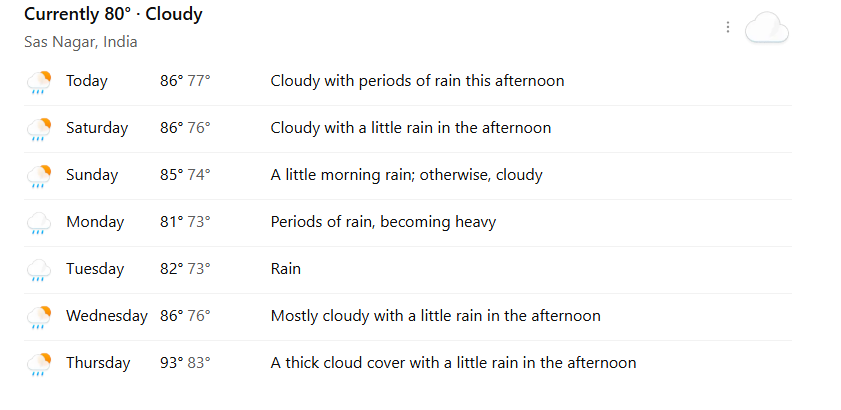
As of Friday, August 29, 2025, Mohali (Sas Nagar) is experiencing a cloudy morning with intermittent rains expected this afternoon. Today’s high is around 30 °C (86 °F), dipping to 25 °C (77 °F) overnight. The coming week continues the trend—frequent rain, especially from September 1–2, with a slight warming by September 4.
Ongoing Waterlogging Challenges
Residential Flooding & Drainage Failures
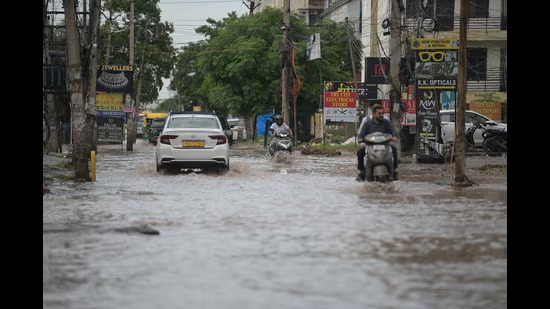
Despite just moderate rainfall today, the city remains on edge—decades of inadequate drainage infrastructure have made even light monsoon spells troublesome. The stormwater system, designed for around 25 mm/hour, falters when heavier showers hit. As a result, low‑lying sectors like Phase 4, 5, 3B1, 3B2, 11 and Sectors 70 & 71 often face waterlogging and even flooding inside homes.
Structural and Planning Flaws
Several underlying factors aggravate these issues:
- Raised road elevations (sector-dividing roads now often sit higher than internal roads and house plinths) block natural runoff paths.
- Poor coordination between agencies—Public Health, MC, and GMADA—has led to disjointed drainage planning and maintenance.
- Silting and clogged drains, especially unchecked seasonal rivulets (choes), compound the problem.
Flashpoints: Today’s Highlights
Civil Hospital Leak
In Phase 6, the Civil Hospital’s under-construction OPD portion experienced leakages due to a faulty rainwater disposal system, which isn’t connected to the building’s harvesting system. Authorities have ordered immediate rectification.
Causeways & Flood Risk Areas
Nearby villages like Jayanti Majri remain vulnerable. The DC has ordered strict monitoring and closures of causeways during high water, as three vehicles were swept away recently. Locals demand permanent bridges; estimates of ₹13–14 crore are awaiting approval.
Additionally, Masol and Jayanti Majri villagers—especially children—still trek over 7 km to school due to destroyed bridges and roads, highlighting the human toll.
Infrastructure Planning: N‑choe Realignment
On a more positive note, an EIA-approved plan to realign, widen, and buffer the N‑choe within the IT City (Sector 82) has moved forward. This aims for better hydraulic flow, mitigation of flooding, and sustainable urban development.
Systemic Gaps & Long-Term Needs
MC Report Recommendations
A prior MC‑commissioned report outlines steps such as:
- Upsizing stormwater pipelines
- Regular desilting using hydro‑vacuum tools
- Adjusting terrain and road elevations
- Installing smart water‑management technologies
The report suggests a total investment of around ₹100 crore, with ₹35 crore pending from GMADA to begin work.
Past Failures and Recurring Damage
- Last year’s first monsoon rain in late June flooded homes across Phases 3B2, 4, 5, 7 and Sectors 70–71—residents were forced to sleep on flooded floors, while fire tenders pumped roads. Officials cited a need for ₹200 crore, yet funds remain elusive.
- Aerocity suffered extreme distress—over 303 mm of rain in 72 hours, followed by prolonged power cuts—even though the area was billed as ‘Singapore‑like’. Only 85% of gullies were cleared before the monsoon, despite a ₹1 crore cleaning budget.
- Just two monsoon rains in June 2025 left parks, roads, playgrounds, and societies submerged—a testament to the ill‑preparedness of MC and GMADA.
Looking Ahead: What Needs to Happen
Short-Term Urgency
- Clean and desilt all road gullies, especially in high-risk zones.
- Deploy temporary pumps and barriers in low-lying residential clusters.
- Enhance monitoring of vulnerable spots, including causeways and hospitals.
- Activate emergency response teams tied to local panchayats to manage rising waters.
Medium to Long-Term Strategy
- Upgrade stormwater infrastructure—expand drains and pipelines, and implement smart water systems.
- Reassess urban design, ensuring roads don’t obstruct natural drainage, and allow for periodic flooding flows.
- Construct permanent bridges in vulnerable villages like Jayanti Majri and Masol.
- Implement drainage realignment projects such as the N‑choe intervention in IT City.
- Allocate and expedite financing—release pending funds (e.g., ₹35 crore from GMADA) and budget for the ₹100 crore overhaul.
- Improve agency coordination—streamline planning and execution across MC, GMADA, Public Health, and other stakeholders.
In Conclusion
On August 29, 2025, Mohali grapples not just with clouds and rain—but with the fallout of years of planning oversights and infrastructural neglect. From struggling residents in flooded homes to exposed hospitals, and treacherous causeways, the city faces a clear crossroads.
But while the problems are knotty and recurrent, solutions exist—and some are underway. The alignment of N‑choe, the proposed structural upgrades, and the media spotlight offer a flicker of hope. What Mohali needs now is follow-through—on funding, execution, maintenance, and visionary planning—to ensure this monsoon doesn’t just wash away the mess, but also lays the foundations for resilience.
Check More Posts
How to Reduce Body Fat Safely and Effectively
Aravind Srinivas’ Perplexity AI Offers $34.5 Billion to Buy Google Chrome